Quick answer
Why is my concrete cracking?
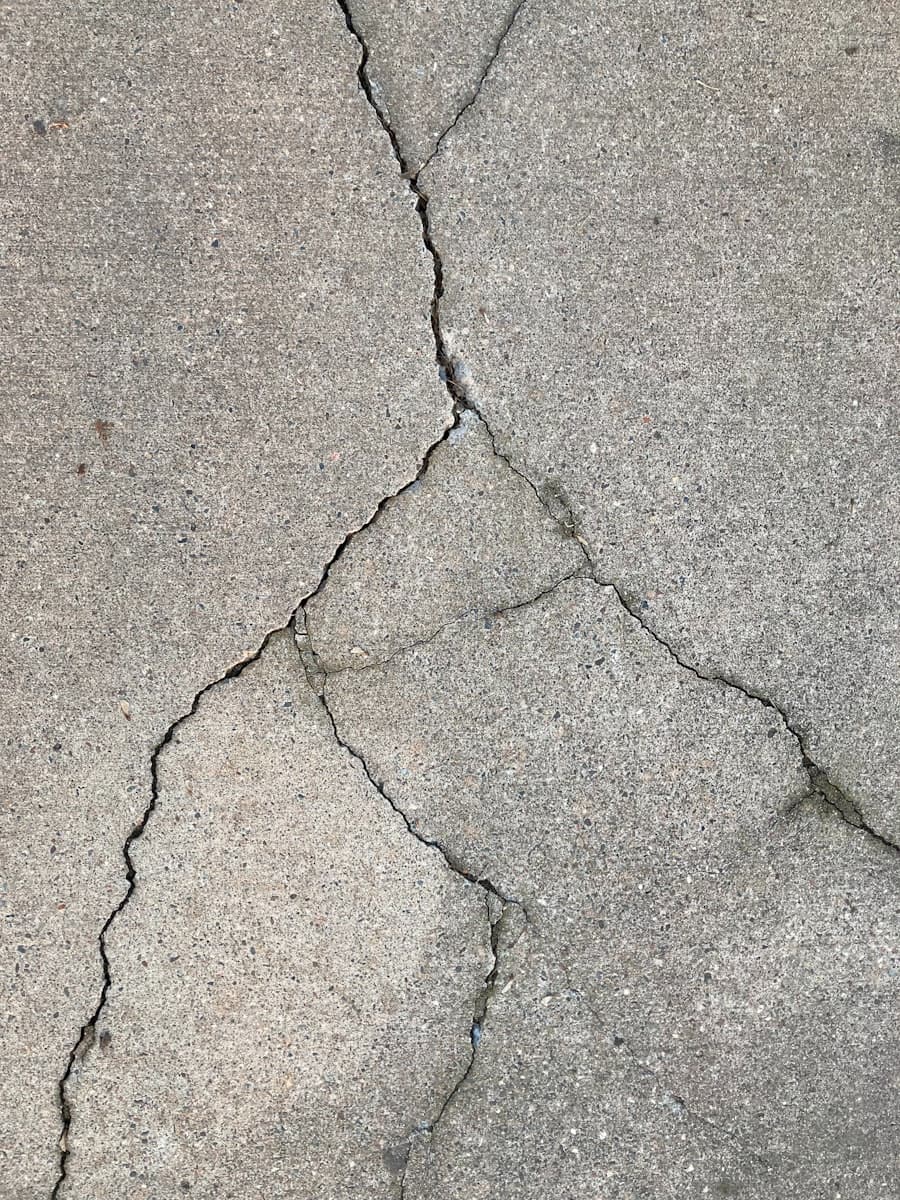
All concrete cracks — it shrinks as it cures and has to release that movement somewhere. The question is which kind of crack you have. Fine random cracks between control joints are normal shrinkage. A straight crack across a panel usually means the joints were spaced too far apart or cut too late. A crack with a height difference across it means the ground underneath has moved, and that one needs attention.
- Normal
- Hairline, level, static
- Watch
- 1/8"–1/4", level
- Assess
- Over 1/4", or growing
- Structural
- Any height difference
The first thing worth saying is that a crack is not automatically a defect. Concrete shrinks roughly a sixteenth of an inch for every ten feet as it cures, and it's about ten times weaker in tension than compression. Put those two facts together and cracking is not a risk to be avoided — it's a certainty to be managed.
What good concrete work does is decide where the cracks go. Control joints are pre-planned lines of weakness cut into the slab so it cracks along the bottom of a groove, out of sight, instead of wandering across the surface. When people say a driveway has no cracks, what they usually mean is that its cracks are in the joints where they belong.
So the useful question isn't whether your concrete has cracked. It's what kind of crack it is, and the pattern tells you almost everything.
Reading the crack pattern
Crack types, causes, and what to do
| What you see | Cause | Seriousness | Action |
|---|---|---|---|
| Fine web of shallow cracks over the surface (map or crazing cracks) | The surface dried faster than the body of the slab, usually from finishing in sun or wind, or from not curing properly | Cosmetic | Nothing structural. Sealing improves appearance and stops dirt lodging in them. |
| A single straight crack across a panel, roughly perpendicular to the long side | Shrinkage with joints spaced too far apart, or cut too late | Low if tight and level | Fill with flexible crack sealant. Monitor width annually. |
| Crack running from a corner of the slab at roughly 45° | A re-entrant corner concentrating stress — a doorway, a post, a change of shape | Low to moderate | Normal where a slab changes shape. Fill and monitor. Preventable with a diagonal joint or corner reinforcement at construction. |
| Crack with one side sitting higher than the other | Differential settlement — the base has moved under one side | Structural | Get it assessed. Filling it treats the symptom; the cause is underneath. |
| Wide crack that has opened over time, with debris in it | Ongoing movement, usually base or drainage related | Structural | Assess. Repeated filling that reopens confirms active movement. |
| Cracking radiating from a single point, often with a depression | Point overload — an RV jack, a dumpster leg, a post base | Moderate | Assess load capacity. Often means the slab is under-thickness for its use. |
| Surface flaking or peeling in sheets, exposing aggregate (scaling) | A weak surface layer — water added on site, poor curing, or finishing water into the surface | Cosmetic to moderate | Not really a crack. Resurfacing is the fix if it's widespread. |
| Small cone-shaped pits with a stone at the bottom (popouts) | A porous or reactive aggregate particle expanding near the surface | Cosmetic | Patch if unsightly. No structural implication. |
The four questions we ask on site
When we look at a cracked slab, four things determine the answer — and you can check all of them yourself.
Assessing a crack yourself
Five minutes with a coin and a straight edge.
Is there a height difference?
Run your foot or a straight edge across the crack. If one side sits higher than the other, the ground has moved and you're looking at a structural issue rather than a shrinkage crack. This is the single most important test.
How wide is it?
Under 1/8 inch — about the thickness of a coin edge — is generally cosmetic. Between 1/8 and 1/4 inch is worth filling and monitoring. Over 1/4 inch warrants a professional look, particularly if it's also uneven.
Is it moving?
Mark the ends of the crack with a pencil and note the date, or measure the width at a marked point. Check again in six months and after a wet winter. A crack that isn't growing is a historical event; one that is has an active cause.
Where is it, and what's above and below?
Cracks that follow a downspout discharge, run parallel to a slab edge, or appear where a tree used to be all point directly at their cause. Look for the pattern, not just the crack.
What's the drainage doing?
Walk the area during or after heavy rain. Most cracking we're called to has a water story behind it, and it's usually visible within five minutes of a downpour.
The three real causes
Strip away the categories and almost all problem cracking comes from one of three things.
Base and drainage failure is the most common by a distance. Water gets into the ground under the slab, the base softens or washes out, the slab loses support over an area, and it cracks trying to span the gap. The tell is a height difference across the crack, and the cure is under the concrete rather than in it. Fixing the crack without fixing the water means fixing the crack again in three years.
Joint layout is second. Control joints need to be cut within roughly 6 to 18 hours of the pour, to about a quarter of the slab depth, on a grid that keeps panels roughly square and no more than about ten to twelve feet across for a 4-inch slab. Cut too late, spaced too far apart, or cut too shallow, and the slab cracks where it wants to instead of where you planned.
Third is overload — usually a slab built for cars carrying something much heavier. An RV, a loaded dumpster, a delivery truck, or a moving van on a 4-inch residential slab concentrates load far beyond what it was designed for. The crack often doesn't appear at the time; it shows up a year or two later and nobody connects the two events.
Concrete almost never fails as a material. It fails as a system — and the part of the system that failed is nearly always underneath it.
What Bay Area soil does
Local conditions matter here, and they're different from what most online advice assumes.
Large areas of Santa Clara and Alameda counties sit on expansive clay — soil that swells substantially when it takes up water in winter and shrinks as it dries through summer. That's a slow annual cycle of lifting and dropping under every slab in the neighborhood. A slab on a well-built, free-draining aggregate base rides it out. A slab poured straight onto clay gets worked a fraction of an inch a year until something gives, and the cracking that follows looks like settlement because functionally it is.
What we don't have is meaningful freeze-thaw damage, which is the dominant cracking and spalling mechanism across most of the country. De-icing salt damage isn't a local factor either. So if you're reading advice about air entrainment and salt-resistant sealers, that's a Midwest conversation. Here, the conversation is about water management and base depth.
When to call someone
Most cracks don't need a professional. These do.
Any crack with a height difference across it. Any crack that's visibly wider than a quarter inch. Any crack that has grown measurably in the last year. Cracking in a foundation wall or slab rather than flatwork — that's a different conversation and sometimes an engineer's one. Multiple parallel cracks appearing across a slab in a short period. And any crack where you can see or feel the base material through it.
It's also worth a call if repairs keep failing. A crack that reopens within a year of being properly filled is telling you there's active movement, and that's information worth acting on early rather than after another two winters.
Cracking questions
What to do next
Key takeaways
- All concrete cracks. Good work decides where — that's what control joints are for.
- The most important test is whether there's a height difference across the crack.
- Under 1/8 inch and level is cosmetic. Over 1/4 inch, or uneven, needs assessing.
- Three real causes: base and drainage failure, poor joint layout, and overload.
- In the Bay Area, expansive clay soil drives most settlement cracking — not freeze-thaw.
- Fill cracks to keep water out of the base, but find the cause as well as the symptom.
Still deciding?
Ask us about your specific project
We'll give you a straight answer on the phone, including when that means telling you that you don't need the work you asked about. Free written estimates across San Jose & the greater Bay Area.