Quick answer
What can I put over an old concrete driveway?
Five options work on an existing slab: resin-bound gravel overlay (premium, no demolition, 25-year life), a micro-topping or bonded overlay (thin resurfacing, cosmetic fix), a stamped concrete overlay (decorative pattern over existing), exposed aggregate (new pour beside or over the old), or full demolition and replacement. Which one fits depends on whether your existing slab is structurally sound — a slab that's settling or has a failing base can't support an overlay and needs to come out.
- Best no-demo option
- Resin-bound overlay
- Cheapest cosmetic fix
- Micro-topping ($4–$8/sq ft)
- Most durable
- Full replacement (30–50 yrs)
- Deciding factor
- Is the sub-base sound?
Start here: is your slab a candidate for an overlay?
The single most important question isn't which overlay to choose — it's whether your slab qualifies for one at all. An overlay bonds to the existing concrete and depends on that concrete to carry the load. If the slab is cracked because the base underneath has settled or failed, an overlay will follow it. If there's delamination — sections of the surface that ring hollow when you tap them — that material has to come off before anything bonds.
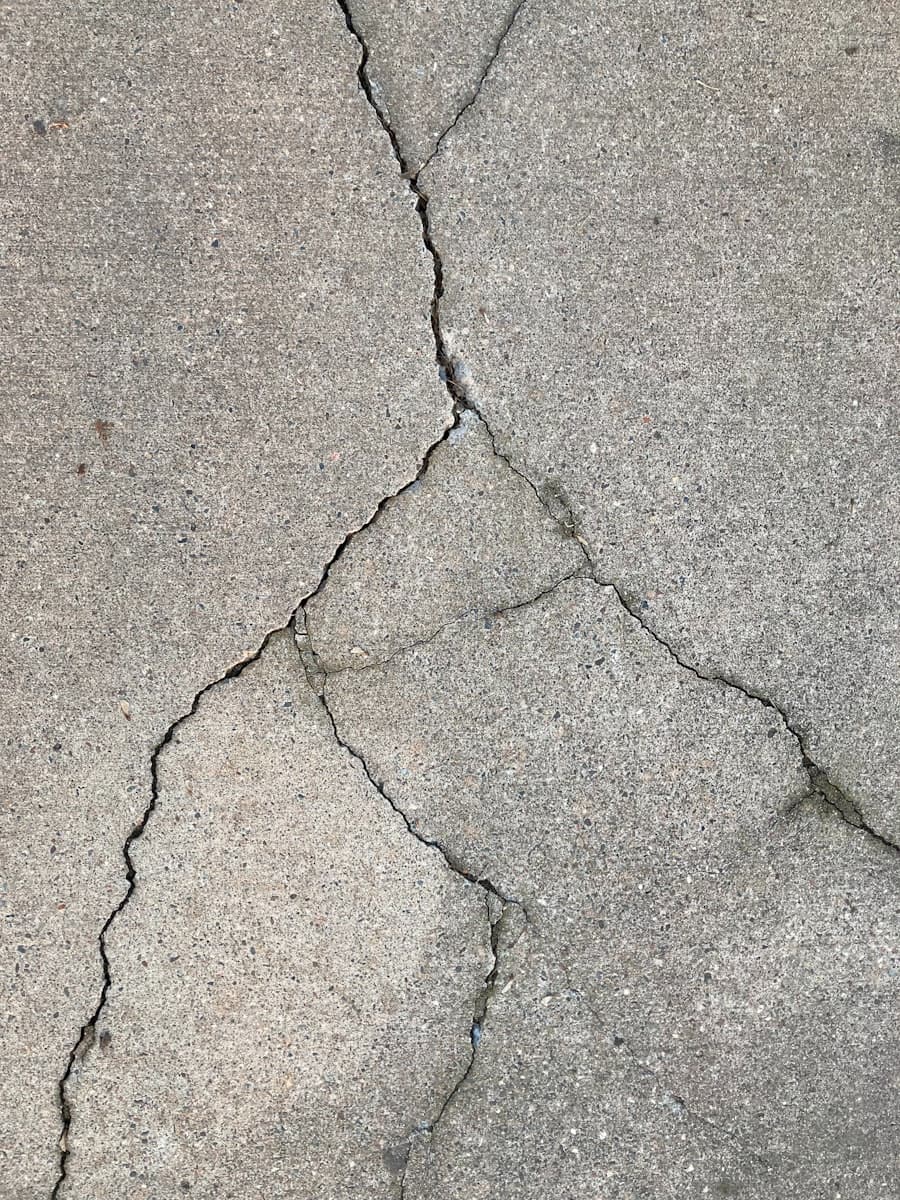
The basic test: walk the driveway and look for cracks with a height difference between the two sides. Level cracks — where both sides of the crack are at the same height — usually indicate shrinkage or joint failures, and those can be managed. Height differences across a crack mean the slab is moving, and an overlay is at best a temporary fix.
If the slab passes that test, you have real options. If it doesn't, the honest recommendation is replacement — and any contractor who doesn't tell you that upfront isn't doing you any favors.
The Five Options Compared
Resin-Bound Gravel Overlay
Natural stone aggregate bound in two-part polyurethane resin, applied 18mm thick over existing concrete. No demolition required when the substrate is sound.
Pros
- No jackhammers, no hauling — the old slab stays and becomes the sub-base
- Seamless, weed-free surface — no joints for weeds or moss to find
- Permeable — water drains through the surface rather than pooling
- Color comes from natural stone, not pigment — UV-stable, won't fade
- 25-year lifespan on a properly installed system
- Drive-on in 24 hours
Cons
- Cannot fix a slab that's actively settling — the overlay will crack too
- Higher upfront cost than basic resurfacing ($18–$28/sq ft installed)
- Requires a skilled installer — poorly mixed resin or rushed laying produces a weak surface
- Not a structural repair — if the base has failed, this is a cosmetic fix on a failing slab
Verdict — Best option for a sound slab you want to genuinely transform — premium result without demolition
Micro-Topping / Bonded Overlay
A polymer-modified cementitious layer applied 3–6mm thick over existing concrete. Cosmetic resurfacing, not a structural upgrade.
Pros
- Lowest cost overlay option — $4–$8 per square foot
- Can be textured, stained, or tinted for a reasonably good cosmetic result
- Fast — applied and cured in one to two days
- Good at hiding surface staining, minor pitting, and cosmetic wear
Cons
- Thinnest bond — at 3–6mm it's the most vulnerable to delamination
- Surface cracks in the original slab will telegraph through over time
- Not vehicle-rated at thin applications — best for foot-traffic areas
- Requires resealing every 2–3 years; worn areas rub through to the original slab
- Will not hide height differences across cracks — those still show
Stamped Concrete Overlay
A thicker polymer overlay (12–25mm) pressed with rubber mats to mimic stone, brick, or tile. A decorative system with more mass than a micro-topping.
Pros
- Wide range of patterns and colors — can genuinely look like stone or pavers
- Thicker than a micro-topping, so more durable and better at bridging surface imperfections
- Can dramatically change the look of a plain driveway without demolition
Cons
- Color hardener and release agent fade over time, requiring periodic resealing
- Bond failure is a real risk — at 12–25mm the overlay is heavy enough to delaminate in sheets if preparation was insufficient
- Patterns repeat visibly — a skilled installer offsets the mats, but it rarely looks as natural as a stamped new pour
- Slippery when wet without a slip-resistant sealer additive
- Cost approaches full replacement at the upper end ($14–$22/sq ft)
Exposed Aggregate (New Pour)
New concrete poured alongside or in sections replacing sections of the old slab, with aggregate exposed at the surface. Partial or full replacement.
Pros
- The aggregate texture is structural — won't chip, fade, or wear away
- Naturally slip-resistant without additives
- Wide range of aggregate options — river stone, quartz, specialty blends
- Can be poured in sections to replace only the damaged areas
Cons
- Partial replacement — mismatched aggregate between old and new is visible
- Full replacement requires demolition of the existing slab
- Color match between adjacent pours is difficult — aggregate lots vary
- Requires proper curing time — typically 7 days before vehicle traffic
Full Demolition and Replacement
The existing slab is broken out, hauled away, and the driveway is rebuilt from the sub-base up.
Pros
- Starts with a clean slate — base failures, drainage problems, and root damage can all be corrected
- Correct the finished grade, joint layout, and thickness all at once
- 30–50 year lifespan from a properly built replacement
- Any finish is available — plain, stamped, stained, or exposed aggregate
Cons
- Most disruptive option — demolition, haul-off, and cure time means a week or more without the driveway
- Highest cost: $14–$22 per square foot for a plain replacement; $20–$32 for a decorative finish
- Necessary when the sub-base has failed, but overkill when the slab is structurally sound
Cost by Option — Two-Car Driveway (~600 sq ft)
All figures are installed cost for the South Bay area, professional installation. DIY cost is not included — none of these are advisable as DIY projects on a vehicle-rated surface.
- Micro-topping / bonded overlay$4–$8
Cosmetic fix only; shortest lifespan of any overlay
- Stamped concrete overlay$14–$22
Decorative; bond failure is the main risk
- Resin-bound gravel overlay$18–$28
No demolition required; 25-year lifespan
- Full replacement — plain finish$14–$22
New slab, any finish; 30–50 year lifespan
- Full replacement — stamped or exposed aggregate$20–$32
Includes premium finish on new pour
per sq ft installed
Substrate repair (crack stitching, base correction) is additional and varies by condition. Any quote that doesn't mention substrate assessment has not priced the real job.
Decision Matrix — Which Option for Your Situation
| Your situation | Best option | Why |
|---|---|---|
| Sound slab, ugly surface, want premium result | Resin-bound overlay | No demolition, 25-year life, natural stone finish |
| Sound slab, cosmetic staining only | Micro-topping or resin-bound | Micro-topping if budget is primary; resin-bound for longevity |
| Sound slab, want stone or paver look | Resin-bound overlay or stamped overlay | Resin-bound for weed-free + permeable; stamped for specific patterns |
| Slab with level cracks, otherwise sound | Resin-bound after crack repair | Cracks filled and stitched, then overlay over sound substrate |
| Slab with height difference across cracks | Full replacement | Active movement can't be overlaid — fix the base first |
| Slab with widespread delamination | Full replacement | Delaminated areas must come off; at that point demo makes sense |
| Failed base, drainage problems, roots | Full replacement | Only replacement corrects base and drainage at the same time |
| Matching existing exposed aggregate sections | New pour — exposed aggregate | Best color match is a new pour in the same mix |
Questions to Ask Any Overlay Contractor
These are the ones that separate contractors who understand the product from those who sell it.
- Did you check for delamination by tapping the surface, or just look at it?
- Are any of the cracks showing a height difference? If yes, what does that mean for the overlay?
- Is the base compacted and draining correctly, or are there low spots holding water?
- What surface preparation will you do before laying? (minimum: clean, prime, fill dormant cracks)
- What is the resin system — two-part polyurethane, epoxy, or polyurea? (for resin-bound specifically)
- What is the aggregate size and source? Can I see samples?
- What is the cure time before vehicles, and is there a warranty?
Frequently asked questions
Ready to Act?
Still deciding?
Ask us about your specific project
We'll give you a straight answer on the phone, including when that means telling you that you don't need the work you asked about. Free written estimates across San Jose & the greater Bay Area.