Structural
Gunite and Shotcrete for Pool Shells, Walls & Slope Stabilization
Sprayed concrete for pool shells, retaining walls, and slope stabilization — placed under pressure where forms aren't practical.
- Methods
- Dry-mix gunite · wet-mix shotcrete
- Typical pool shell
- 6"–12" per engineering
- Applications
- Shells, retaining walls, slope facing
- Estimates
- Free & written
Gunite & Shotcrete — At a Glance
Sprayed concrete for pool shells, retaining walls, and slope stabilization — placed under pressure where forms aren't practical. Dueling Trowels Concrete Solutions provides gunite & shotcrete services across 55 cities in Santa Clara, Alameda, San Mateo, and Santa Cruz counties, including San Jose, Oakland, Fremont, and Sunnyvale. Licensed, insured, and backed by a written workmanship warranty. Free written estimates.
01
Concrete That's Sprayed Instead of Poured
Gunite and shotcrete are both concrete applied pneumatically — shot through a hose at high velocity onto a reinforced surface rather than poured into forms.
The reason to do that is shape. A pool shell is a curved, tapering, free-form vessel; a slope face follows whatever contour the hillside already has; a retaining wall cut into a bank has soil on one side and nothing to form against. Building conventional formwork for any of those is either impossible or costs more than the concrete does.
Sprayed concrete solves it by needing only one side. The material is shot against the excavated face or the reinforcing cage, compacts itself on impact from the velocity alone, and stands up on its own — so a curved pool floor, a vertical wall face, and an overhanging bench can all be built in the same pass without a single form panel.
The result is structurally real concrete, not a coating. Properly applied, it reaches strengths comparable to or higher than cast-in-place concrete, largely because the placement pressure drives out voids that vibration has to work for in a formed pour.
Gunite vs. Shotcrete — the Actual Difference
The two names get used interchangeably, and shouldn't be. The difference is where the water is added, and it changes how the job runs.
Gunite (Dry-Mix)
- Dry cement and sand travel through the hose; water is added at the nozzle
- The nozzleman controls water content in real time, by feel and eye
- Can be stopped and restarted freely — good for long or interrupted days
- The traditional method for residential pool shells
- Quality depends heavily on the nozzleman's skill
Shotcrete (Wet-Mix)
- Concrete is batched wet at the plant and pumped ready-mixed to the nozzle
- Water-cement ratio is fixed and verifiable before it reaches the site
- Higher output — better suited to walls and large structural placements
- Less rebound waste and less dust on site
- Consistency is controlled at the batch plant, not at the nozzle
Where We Use It
Three applications cover almost all of the sprayed concrete work in this area.
Pool & Spa Shells
Floor, walls, steps, benches, and spa dam walls shot as one continuous monolithic shell over a tied rebar cage. Free-form shapes, vanishing edges, and tapered floors are built directly — there's no form geometry limiting what the shell can be.
Retaining Walls
Walls built against a cut bank where there's no room or access to form and strip a conventional wall. Common on the hillside lots around Los Gatos, Saratoga, and the Oakland and Berkeley hills, where the cut face is the back form.
Slope Stabilization
A reinforced facing sprayed over an eroding or unstable slope, typically tied back with soil nails or anchors designed by an engineer. Follows the existing contour instead of requiring the slope to be reshaped for formwork.
What a Sound Application Requires
Sprayed concrete is more dependent on workmanship than almost any other placement method. These are the controls that separate a shell that lasts thirty years from one with voids behind the steel.
- Reinforcing steel tied to the engineered spacing and held off the substrate on chairs, so material can encase it from behind
- An experienced nozzleman holding the correct distance and a perpendicular angle to the surface — the two variables that decide compaction and rebound
- Shooting from the bottom up on vertical work, with rebound removed continuously rather than shot over
- Rebound never reused as material — it's the segregated sand and coarse aggregate that bounced off, and it has no place in the structure
- Thickness verified against the design with depth pins or probes as the work proceeds, not estimated afterward
- Wet cure or a curing compound applied promptly — sprayed sections are thin, high in surface area, and dry out fast
The Nozzleman Is the Job
In a formed pour, mistakes at placement can be corrected with vibration and screeding. In sprayed concrete, the operator's position, angle, and distance at the nozzle determine compaction, thickness, rebound, and whether voids form behind the reinforcing steel — and none of that is visible once the surface is troweled. Certified, experienced nozzlemen are not a premium line item on this work; they are the reason the structure performs.
Curing Matters More Here Than Anywhere Else
A sprayed section has far more surface area relative to its volume than a slab does, and it's frequently applied to a vertical or overhead face in full sun. Both conditions pull water out of the concrete quickly, and concrete that loses its mix water to evaporation instead of hydration never reaches the strength it was designed for.
On pool shells that means keeping the shell wet — genuinely wet, several times a day for the first week, longer in warm dry weather. It is the single most common thing skipped on residential pool projects, and the surface crazing and soft spots that follow are entirely preventable.
On walls and slope facings we typically use a curing compound instead, since keeping a vertical face continuously damp for days isn't realistic on most sites. Either approach works; leaving it to the weather does not.
Gunite & Shotcrete Questions
Building a Wall That Doesn't Need Shotcrete?
Gunite and shotcrete earn their keep on a cut hillside face with no room to form. Most yard-grade retaining walls don't need that — they're built conventionally instead.
More Structural & Foundational Services
Related work we handle, often on the same project as this one.
Often Quoted Alongside This
Work from our other category that regularly shows up on the same site visit.
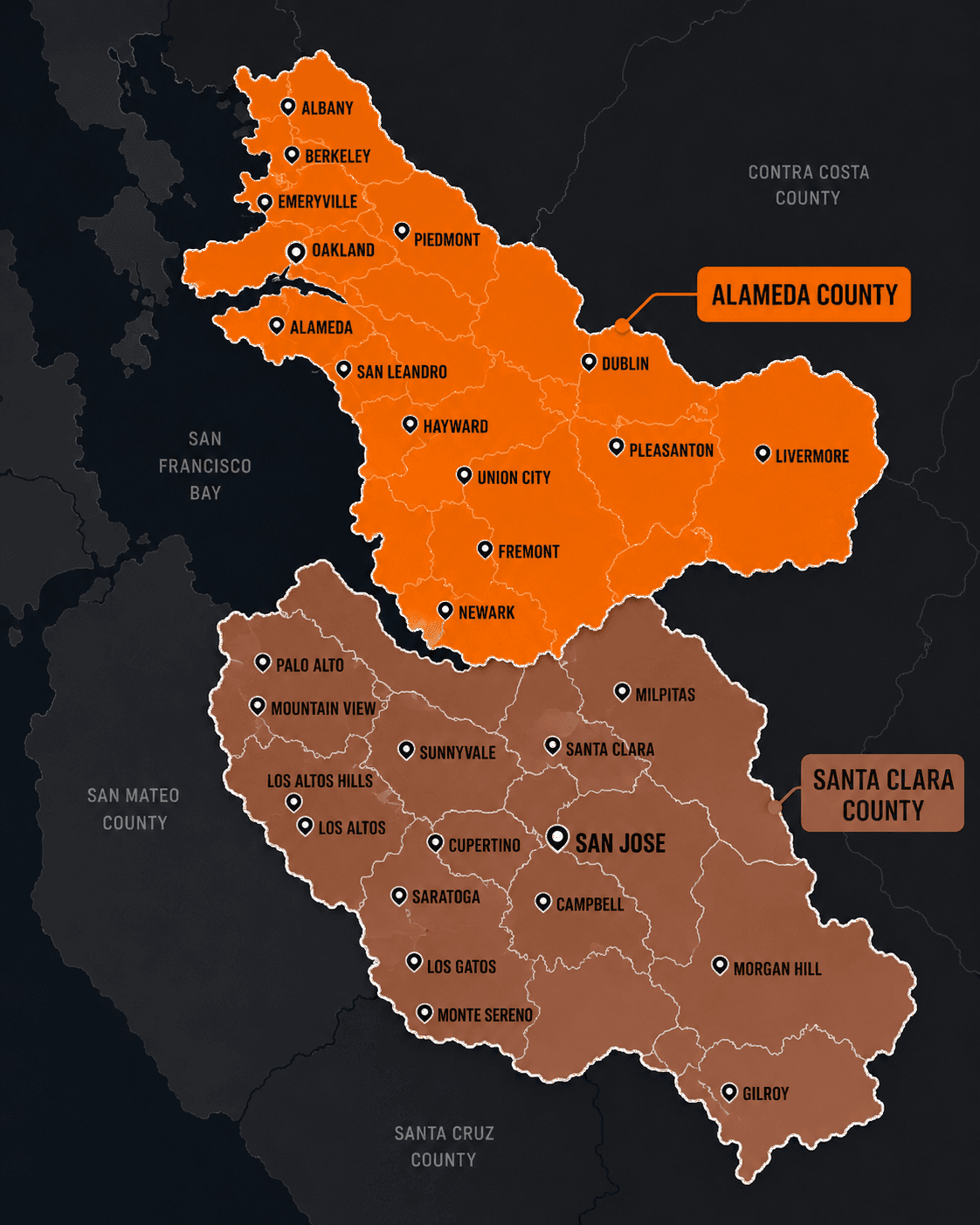
55 Cities Served
Santa Clara, Alameda, San Mateo & Santa Cruz counties
Service Area
Where We Provide Gunite & Shotcrete
We provide gunite & shotcrete across 55 cities in Santa Clara, Alameda, San Mateo, and Santa Cruz counties. Ground conditions, permitting, and the failure modes we see vary city by city, so each has its own page.
Counties
Read Before You Decide
Guides from our Learning Center that bear directly on this kind of work.
Have a Shell, Wall, or Slope to Build?
Send us the plans or the engineer's design and we'll price the sprayed concrete scope — including the reinforcing, the thickness verification, and the cure.