Quick answer
What is concrete?
Concrete is a composite material made from cement, water, sand, and crushed stone. The cement and water react chemically to form a paste that hardens and binds the sand and stone into a single solid mass. Cement is one ingredient in concrete — roughly 10–15% of the mix — not another word for it.
- Main ingredients
- Cement, water, sand, aggregate
- Cement content
- ~10–15% by volume
- Reaches design strength
- 28 days
- Realistic service life
- 30–50 years
Concrete is the most used building material on earth after water, and almost nobody can describe what it is. That's not a knock on anyone — it looks like gray stone, it arrives in a truck, and it goes hard. There isn't much prompting you to look closer.
But understanding the basic composition changes how you read a quote. Nearly every meaningful difference between two estimates comes down to decisions about the four ingredients below and what's underneath them. Once you know what the ingredients do, phrases like "4,000 PSI mix" and "3/4-inch aggregate" stop being jargon and start being specification.
Cement is not concrete
This is the single most common confusion in the trade, and it's worth clearing up first. Cement is a fine gray powder. Concrete is the finished material. Cement is to concrete what flour is to bread — an essential ingredient, but not the thing itself.
You cannot build a driveway out of cement. Poured on its own, cement paste is brittle, shrinks dramatically, and cracks apart. It only becomes useful when it's binding something together. When someone says "a cement driveway," they mean a concrete driveway. It's harmless in conversation, but if it appears in a written specification, that contractor may be less precise than you want.
The four ingredients, and what each one does
A standard concrete mix has four components. Change the proportions and you change the strength, the workability, the finish, and the cost.
What's in the mix
| Ingredient | Roughly | What it does |
|---|---|---|
| Portland cement | 10–15% | The binder. Reacts with water to form the paste that glues everything else together. The most expensive ingredient, and the one that drives strength. |
| Water | 15–20% | Triggers the chemical reaction and makes the mix workable. The single most abused ingredient on a job site — see below. |
| Sand (fine aggregate) | 25–30% | Fills the gaps between the larger stones so the paste has less empty space to bridge. Affects how smooth a finish you can achieve. |
| Crushed stone (coarse aggregate) | 40–45% | The structural bulk. Cheap, hard, and dimensionally stable. More stone means less shrinkage and less cement — which is why aggregate size shows up on specs. |
Proportions vary by mix design. Admixtures — air-entrainers, water reducers, fibers, accelerators — make up well under 1% by volume but can change the behavior of the mix significantly.
Concrete doesn't dry. It cures.
This is the fact that explains the most about concrete's behavior, and almost nobody outside the trade knows it.
Paint dries: the water evaporates and what's left behind is the paint. Concrete does something completely different. The cement and water undergo a chemical reaction called hydration, in which they combine to form microscopic interlocking crystals. Those crystals grow into and around each other and around every grain of sand and stone, gradually locking the whole mass together.
The water isn't leaving. It's being consumed and chemically bound into the structure. That's why concrete can cure underwater — hydration doesn't need air, it needs water. And it's why keeping fresh concrete damp for the first several days makes it stronger, which feels counter-intuitive to everyone the first time they hear it.
It's also why the timeline is so long. The reaction starts within hours and continues for years, slowing down the whole time. Concrete reaches roughly 70% of its design strength in seven days, is specified at 28 days, and keeps very slowly gaining strength for decades afterward.
What happens in the first 28 days
Strong in compression, weak in tension
Concrete is extraordinarily good at being squashed and remarkably bad at being pulled apart. A typical residential mix will take around 4,000 pounds per square inch of compressive load. Its tensile strength — its resistance to being stretched — is roughly a tenth of that.
Every design decision in concrete construction follows from that asymmetry. It's why we put steel in it: steel is excellent in tension, so reinforcing bar handles the pulling forces that concrete can't. It's why rebar has to sit in the middle third of the slab rather than on the ground, because that's where the tension actually occurs when a slab flexes. And it's why concrete cracks.
A slab that's supported evenly underneath is only ever in compression, and it lasts indefinitely. A slab with a soft spot underneath has to span the gap, which puts the bottom of the slab in tension, which is exactly the thing it's worst at. The crack that follows isn't a defect in the concrete. It's the base failing, and the concrete reporting it.
Concrete almost never fails as a material. It fails as a system — and the part of the system that failed is nearly always underneath it.
Why concrete is designed to crack
As concrete cures it shrinks slightly — on the order of a sixteenth of an inch for every ten feet. Over a thirty-foot driveway that's a meaningful amount of movement, and the slab has to release it somewhere.
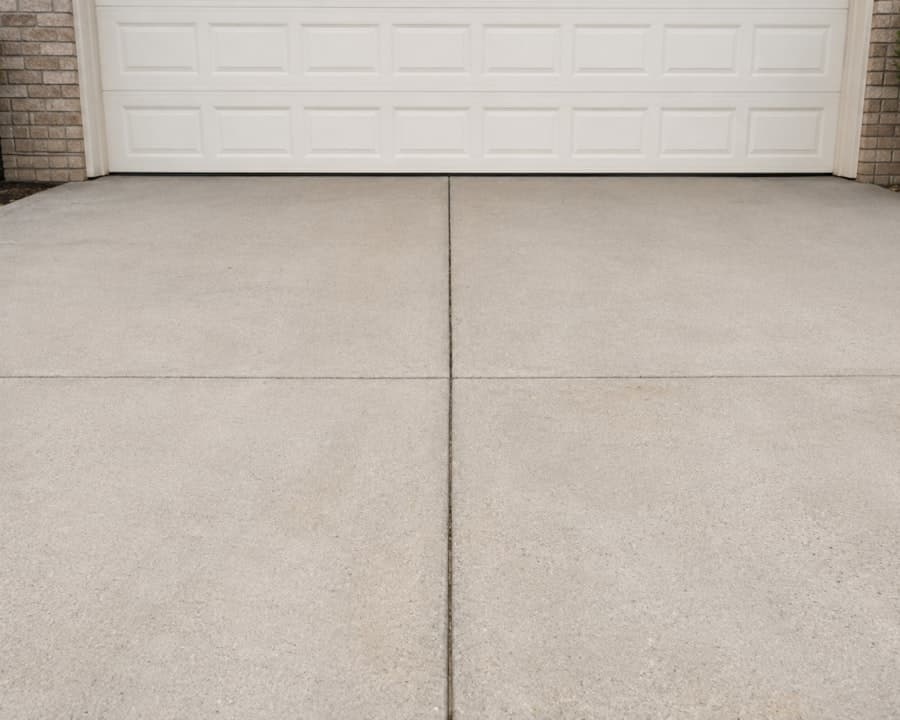
Rather than let it crack randomly, we decide where. Control joints are cut into the slab within the first day, typically to about a quarter of its depth, on a grid sized to the slab. Those grooves create a deliberate line of weakness, and when the slab shrinks it cracks along the bottom of the joint, out of sight, instead of wandering across the surface.
So the joints in your driveway aren't decorative and they aren't where separate pours meet. They're pre-planned cracks. A driveway with no joints will still crack — it just gets to choose where.
Terms you'll see on an estimate
The vocabulary that shows up on quotes, in roughly the order you'll encounter it.
- PSI
- Pounds per square inch — the compressive strength the mix is designed to reach at 28 days. Residential flatwork is typically 3,000–4,000 PSI; commercial and structural work runs 4,000–4,500 and up.
- Slump
- A measure of how wet and workable the mix is, from a standardized cone test. Higher slump is easier to place and weaker. A 4-inch slump is typical for flatwork.
- Aggregate
- The sand and stone in the mix. Coarse aggregate is usually specified by maximum size — 3/4-inch is standard for flatwork.
- Sub-base / base
- The compacted layer of crushed rock the slab sits on. Usually 4–6 inches of Class 2 aggregate base. This is the layer that determines lifespan.
- Subgrade
- The native soil underneath the base, graded to fall and compacted before anything is placed on it.
- Rebar
- Deformed steel reinforcing bar, sized by eighths of an inch — #4 rebar is half an inch in diameter. Tied into a grid and chaired up into the slab.
- Chairs
- Small supports that hold rebar at the correct height during the pour so it ends up in the middle third of the slab rather than lying on the base.
- Control joint
- A groove cut or tooled into the slab to force shrinkage cracking to occur along a planned line.
- Expansion joint
- A full-depth gap with compressible filler where the slab meets a fixed structure, letting the two move independently.
- Screed
- To strike off fresh concrete level with the forms. Also the tool used to do it.
- Float / trowel
- Finishing operations. Floating levels and embeds the aggregate; troweling closes and hardens the surface.
- Curing
- Deliberately keeping the slab moist and at a stable temperature while hydration proceeds. Not the same as simply waiting.
What actually determines how long it lasts
Given identical concrete from the same truck, two slabs can have wildly different lifespans. The variables that matter, in rough order of importance:
The things that decide a slab's lifespan
0 of 8 checked
Common questions about concrete
Key takeaways
- Concrete is cement, water, sand, and stone — cement is one ingredient, not a synonym.
- It cures through a chemical reaction rather than drying, which is why it can harden underwater and why keeping it damp makes it stronger.
- It's roughly ten times stronger in compression than tension, which is why steel reinforcement exists and why cracks form where the slab has to span a soft spot.
- Control joints are pre-planned cracks. A slab without them still cracks; it just picks the location itself.
- Base preparation and drainage decide lifespan far more than the concrete itself does.
Still deciding?
Ask us about your specific project
We'll give you a straight answer on the phone, including when that means telling you that you don't need the work you asked about. Free written estimates across San Jose & the greater Bay Area.