Quick answer
What is exposed aggregate concrete?
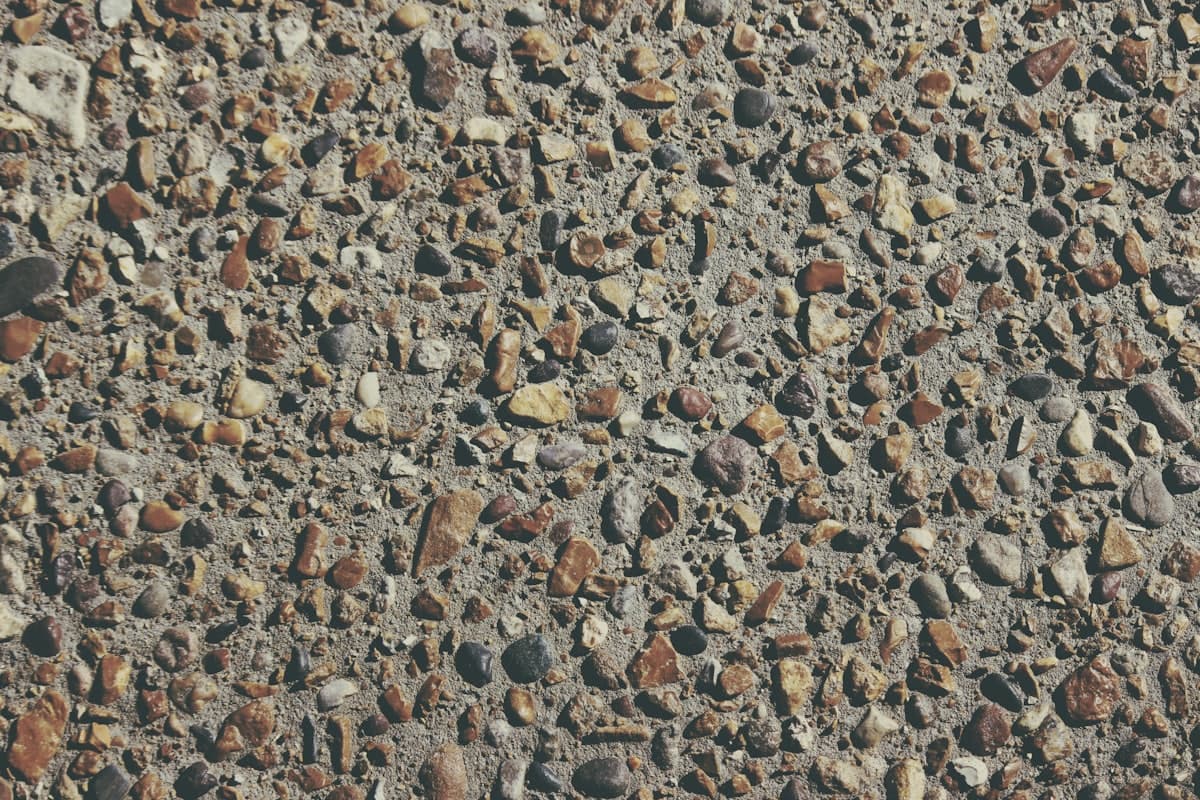
Exposed aggregate concrete is concrete with the top layer of cement paste removed before it fully hardens, revealing the sand and stone within the mix. The result is a durable, heavily textured surface with natural color from the aggregate itself. It has the best wet traction of any concrete finish, hides staining exceptionally well, and wears extremely slowly because the wearing surface is stone rather than paste.
- Typical cost
- $13–$22 / sq ft
- Wet traction
- Best of any finish
- Common uses
- Driveways, pool decks, paths
- Resealing
- Every 2–3 years
Exposed aggregate is the finish professionals recommend most often and homeowners ask for least often, which is largely a marketing problem — it doesn't photograph as dramatically as stamped work, so it rarely appears on inspiration boards.
What it does have is the best combination of practical properties available. Because the wearing surface is stone rather than cement paste, it's genuinely hard-wearing under turning tires. Because the stone protrudes above the surface, it grips when wet better than any texture that can be applied to a smooth slab. And because the surface is visually busy, it absorbs oil spots, tire marks, and general staining in a way a uniform gray slab simply doesn't.
How the aggregate gets exposed
How it's made
There are three ways to get the stone to the surface, and which one is used affects both the cost and the result.
Surface retarder is the most common professional method. A chemical retarder is sprayed onto the fresh surface, which delays the set of the top few millimeters of paste while the concrete beneath hardens normally. The next day, the retarded paste is washed off with a pressure washer, revealing the aggregate cleanly and consistently. Because the timing window is a day rather than an hour, it's far more controllable than the alternative.
Washing and brushing is the traditional method: as the slab reaches the right stage of set, the crew washes and brushes the surface to remove paste. It works, it's cheaper, and it depends entirely on judging a narrow window correctly. Too early and stones dislodge; too late and the paste won't come off.
Seeded aggregate is the premium approach. Decorative stone — often a specific color or size not present in the base mix — is broadcast onto the fresh surface and floated in, then exposed by one of the methods above. It gives complete control over the appearance and costs more, but it's how you get a specific look rather than whatever the local aggregate supply happens to be.
Aggregate choices and how they look
| Aggregate | Appearance | Notes |
|---|---|---|
| Standard local river rock | Mixed grays, tans, and browns, rounded | The default — whatever is in the standard mix. Cheapest and perfectly good. |
| Pea gravel | Small, rounded, uniform | Smoothest underfoot of the exposed options. Good around pools. |
| Crushed granite | Angular, speckled gray with mica glint | More contemporary and harder wearing. Sharper underfoot. |
| Quartz | Bright white to cream, reflective | Pale and cool underfoot — good for hot inland exposures. Premium price. |
| Basalt | Dark gray to near black, angular | Modern and dramatic. Gets hot in full sun. |
| Recycled glass | Colored, highly reflective | A statement finish, mostly for feature areas rather than whole driveways. |
Seeded aggregate — broadcasting chosen stone onto the surface — is what makes the non-standard options possible. Expect roughly $3–$6 per square foot over standard exposure.
Where it's the right choice
Three situations where exposed aggregate outperforms everything else.
Sloped driveways. Wet traction is a genuine safety issue on a slope, and protruding stone gives mechanical grip that no applied texture matches. This is the finish we push hardest for on steep Bay Area driveways.
Pool surrounds and wet areas. Same reasoning, plus the surface hides the mineral staining and leaf tannin that pool decks accumulate. Use a smaller, rounded aggregate so it stays tolerable barefoot.
High-traffic paths and commercial walkways. Stone wears far slower than paste, so an exposed aggregate walkway looks the same in year fifteen as year one, where a broom finish will have polished smooth in the traffic line.
Honest pros and cons
Exposed aggregate
Pros
- Best wet traction of any concrete finish
- Hides oil, tire marks, and general staining better than anything else
- Wearing surface is stone, so it wears extremely slowly
- Natural color variation that doesn't fade — the color is the rock
- No pattern to look repetitive or dated
- Costs meaningfully less than stamped work
Cons
- Rough underfoot barefoot, especially with angular aggregate
- Harder to sweep and to shovel
- Dirt lodges between stones and needs a stiff brush rather than a rinse
- Furniture legs can catch, and small wheels struggle
- Timing-sensitive to install — an inexperienced crew can dislodge stone or under-expose
Verdict — The best practical finish for driveways, slopes, and pool surrounds. Less suited to a patio where people are barefoot and furniture moves constantly.
Maintenance
Broadly the same as any exterior concrete, with two differences.
Sealing matters more for appearance than on plain concrete, because a good sealer wets the stone and brings out its color — an unsealed exposed aggregate surface looks noticeably duller and grayer. Most people prefer the sealed look enough to keep the cycle up on aesthetic grounds alone.
Cleaning takes slightly more effort because dirt sits in the profile. A stiff brush and a concrete cleaner does it; a hose alone doesn't. On the other hand, staining that would be permanent and obvious on a smooth slab often simply disappears into the texture here.
The one genuine failure mode to watch for is popouts — individual stones working loose. That's almost always a sign the surface was exposed too early, before the paste around the stones had gained enough strength to hold them. It shows up in the first year or two, and it's a workmanship issue rather than a material one.
Exposed aggregate questions
Related reading
Key takeaways
- Exposed aggregate removes the top paste layer to reveal the stone in the mix.
- It has the best wet traction of any concrete finish and hides staining better than anything else.
- Because the wearing surface is stone, it wears far slower than a paste-finished slab.
- Seeding decorative aggregate gives color control; standard exposure gives you whatever the plant supplies.
- Small rounded aggregate for barefoot areas; angular crushed rock for driveways and slopes.
- Popouts in the first year mean it was exposed too early — a workmanship issue, not a material one.
Still deciding?
Ask us about your specific project
We'll give you a straight answer on the phone, including when that means telling you that you don't need the work you asked about. Free written estimates across San Jose & the greater Bay Area.