Quick answer
What causes foundation settlement?
Four mechanisms account for nearly all of it. Expansive clay soil swells when wet and shrinks when dry, cycling the foundation up and down seasonally. Poorly compacted fill consolidates under load over years. Water — from bad drainage, plumbing leaks, or irrigation — softens or erodes soil beneath footings. And large trees draw moisture out of clay soil, causing it to shrink away from foundations. In the Bay Area, the first and third are by far the most common.
- Most common local cause
- Expansive clay + water
- Typical seasonal movement
- Fractions of an inch
- Cheapest intervention
- Drainage correction
- Structural fix
- Underpinning / piering
Foundations don't sink because concrete gets tired. They move because the ground they're sitting on changes — and the ground changes almost entirely because of water.
That's the single most useful thing to understand about settlement. Once you see it as a soil moisture problem rather than a concrete problem, the diagnosis and the remedy both make far more sense, and it becomes obvious why so much repair work fails: it treats the concrete and ignores the water.
Expansive clay — the Bay Area's dominant mechanism
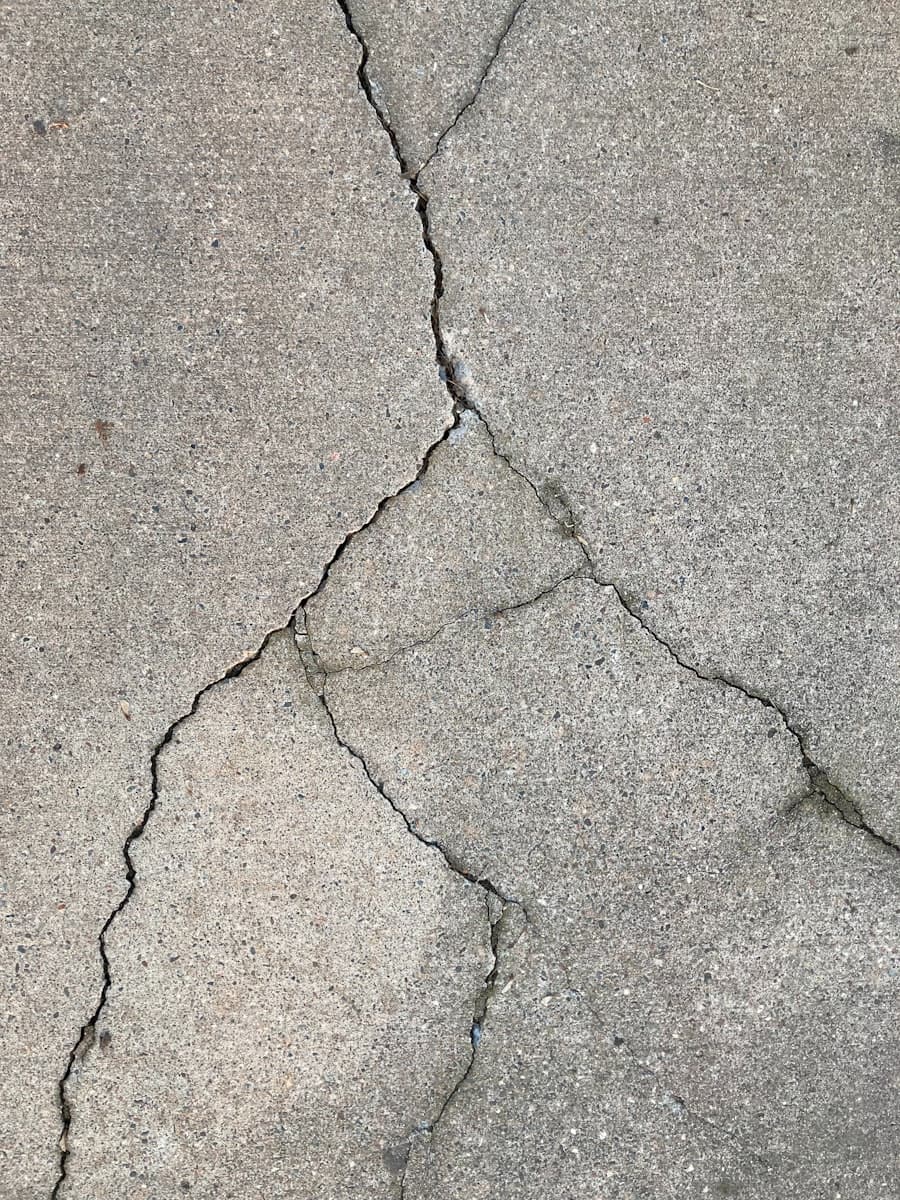
Large parts of Santa Clara and Alameda counties sit on clay soils with a high proportion of expansive minerals. These take water into their crystal structure and physically swell — meaningfully, not marginally. As they dry through summer they shrink again, and can crack open at the surface.
Under a house, that means the ground rises in winter and drops in summer, and it doesn't do so uniformly. Soil around the perimeter, exposed to rain and sun, moves far more than soil under the center of the building, which is shielded and stays at a more constant moisture content. The result is a slow annual cycle of edge lift and edge drop that racks the structure a fraction of an inch at a time.
This is why Bay Area foundation problems are so often seasonal in character, why they appear gradually rather than suddenly, and why post-tensioned and stiffened slab designs are standard on known expansive sites. It's an engineering problem with well-understood engineering answers — but only if it's identified before the foundation is designed.
Poor compaction and fill
The second mechanism is straightforward: soil that was never properly compacted continues consolidating under the weight of the building.
This is most common on sites where the ground was cut and filled to create a level building pad, and where the fill was placed without adequate compaction or moisture control. It also occurs where organic material — topsoil, roots, buried debris — was left in place and later decomposed, leaving voids.
Fill-related settlement typically shows up in the first few years after construction and then slows. It's often uneven, because the depth of fill varies across a site — one corner of a house on eight feet of fill and another on native ground will move differently, which is exactly the differential movement that damages structures.
Water — the accelerant behind everything
Water is rarely the sole cause and almost always the aggravating factor. Four sources come up repeatedly.
Surface drainage: ground sloping toward the house, downspouts discharging at the foundation, and hardscape draining the wrong way all concentrate water exactly where you least want it. This is the most common contributor we find and the cheapest to fix.
Plumbing leaks: a slow leak in an under-slab supply or waste line saturates soil continuously and locally, which on clay causes swelling and on loose fill causes erosion and washout. Unexplained damp patches, a rising water bill, or a warm spot on a slab floor all warrant investigation.
Irrigation: sprinklers and drip lines running close to the foundation keep perimeter soil at a moisture content wildly different from the soil under the house. On expansive clay that's a permanent differential, and it's completely avoidable.
And gutters: a blocked gutter overflowing at one corner of a house delivers a remarkable volume of water into one small area of ground, every time it rains.
Trees and vegetation
Large trees near a house affect foundations mainly through moisture rather than roots. A mature tree can draw a very large volume of water from the soil daily, and on expansive clay that drying causes shrinkage and ground level to drop within the root zone.
The effect is often seasonal and directional — worse in summer, worse on the side of the house nearest the tree — which makes it fairly diagnosable.
The counter-intuitive part is removal. Taking out a mature tree beside a house on clay soil doesn't just stop the drying; it allows the soil to rehydrate over subsequent years and swell back, which can cause heave. Where a large tree is close to a foundation on expansive soil, removal is a decision worth taking advice on rather than doing casually.
Root damage to flatwork is a separate and much more common issue. Roots lifting a driveway, path, or patio is normal, visible, and doesn't imply anything about the house foundation.
Mechanism, signature, and remedy
| Cause | How it presents | Typical remedy |
|---|---|---|
| Expansive clay | Seasonal movement — doors sticking in winter and easing in summer; edge lift or drop; gradual worsening over years | Moisture stabilisation around the perimeter, drainage control, and where necessary piering below the active zone |
| Poorly compacted fill | Movement in the first few years after construction, often at one corner or one side | Underpinning to competent material; void filling by injection |
| Surface drainage | Localised movement near a downspout, a low spot, or hardscape draining toward the house | Regrade, extend downspouts, correct hardscape fall. Often the whole fix |
| Plumbing leak | Localised, non-seasonal, sometimes with damp flooring or a rising water bill | Locate and repair the leak, then assess whether the soil needs remediation |
| Tree moisture demand | Seasonal, worse in summer, concentrated on the side nearest the tree | Root barriers, managed irrigation, and careful consideration before removal |
| Erosion or slope movement | Progressive, often on hillside properties, sometimes with visible ground cracking | Geotechnical assessment. This is engineering territory, not contractor territory |
How settlement is actually repaired
When structural repair is genuinely needed, three approaches cover most residential work.
Underpinning with piers transfers the load past the problem soil. Push piers are driven hydraulically to refusal against a competent layer using the building's own weight as a reaction; helical piers are screwed in to a specified torque. Both can stabilise a foundation and, where practical, lift it partially back toward level. This is the standard structural remedy.
Grout and polyurethane injection fills voids beneath a slab and can re-level it. It's less invasive and less expensive than piering, and it's appropriate where the problem is a void rather than inadequate bearing capacity.
And drainage and moisture management — which sounds trivial next to the others and is frequently the most important element of the whole scheme. In many cases it's specified alongside structural work; in some cases it's the only thing needed.
All three should follow an engineering assessment. Foundation repair is one of the few areas of construction where the diagnosis genuinely requires a different professional from the person doing the work.
Settlement questions
Related reading
Key takeaways
- Foundations move because the soil changes, and soil changes because of water.
- Expansive clay is the dominant Bay Area mechanism — seasonal swelling and shrinking.
- Poorly compacted fill consolidates over the first few years and usually moves unevenly.
- Drainage correction is the cheapest intervention and frequently the whole answer.
- Repairing settlement without identifying its cause guarantees it comes back.
- Diagnosis belongs to an engineer; execution belongs to a contractor. They're different jobs.
Still deciding?
Ask us about your specific project
We'll give you a straight answer on the phone, including when that means telling you that you don't need the work you asked about. Free written estimates across San Jose & the greater Bay Area.